Working Principle
Image sensors that work with the photoelectric effect convert photons into electrical charge. Unlike CCD sensors (Charge-Coupled Device), CMOS sensors (Complementary Metal-Oxide Semiconductor) convert charge directly into voltage at the pixels. Voltage amplification and digitization create the output digital value.
Today's CMOS sensors are distinguished by high frame rates and outstanding image quality. They provide precise image evaluation in high-performance industrial cameras. In most applications, CCD sensors have been replaced by CMOS sensors with developing technology.
The following illustration explains the basic functions and main features of CMOS sensors.
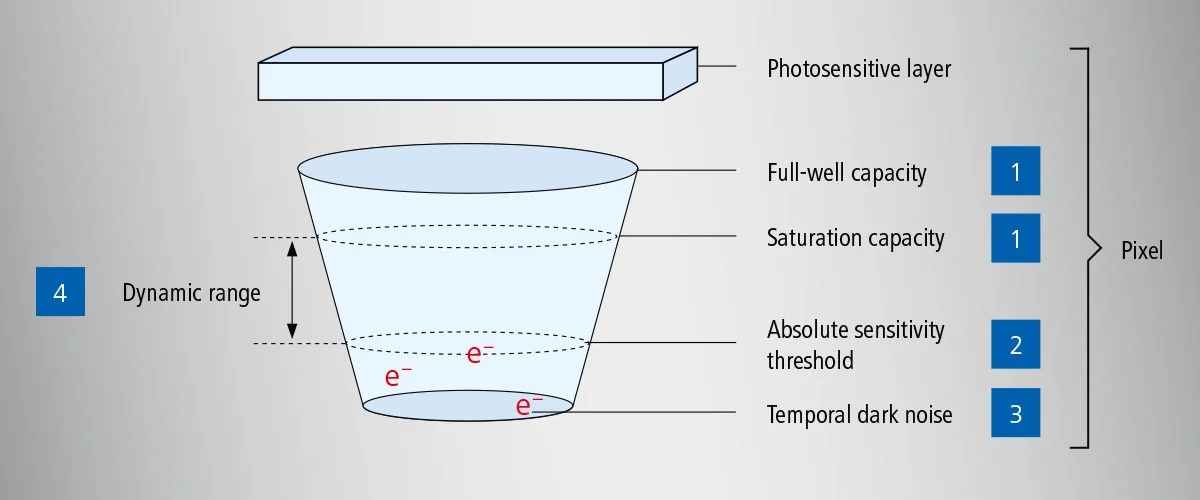
1. Full Well Capacity [e–] and Saturation Capacity [e–]: Think of a pixel as a well and consider the full-well capacity as the maximum number of electrons that can be stored in this well. The saturation capacity is measured differently for camera characterization and is usually smaller than the full-well capacity. High saturation capacity allows longer exposure times.
2. Absolute Sensitivity Threshold (AST) [e–]: Defines the lowest number of photons at which the camera can distinguish useful image information from noise. A lower AST means the camera is more sensitive.
3. Transient Dark Noise [e–]: Each pixel shows a (dark) signal even when the sensor is not illuminated. This dark signal increases with time and temperature and is called dark noise. Low dark noise is preferred for most applications.
4. Dynamic Range [dB]: It refers to the ratio between saturation irradiance and minimum detectable irradiance. Cameras with high dynamic range provide more detailed information for dark and bright areas in a single image.
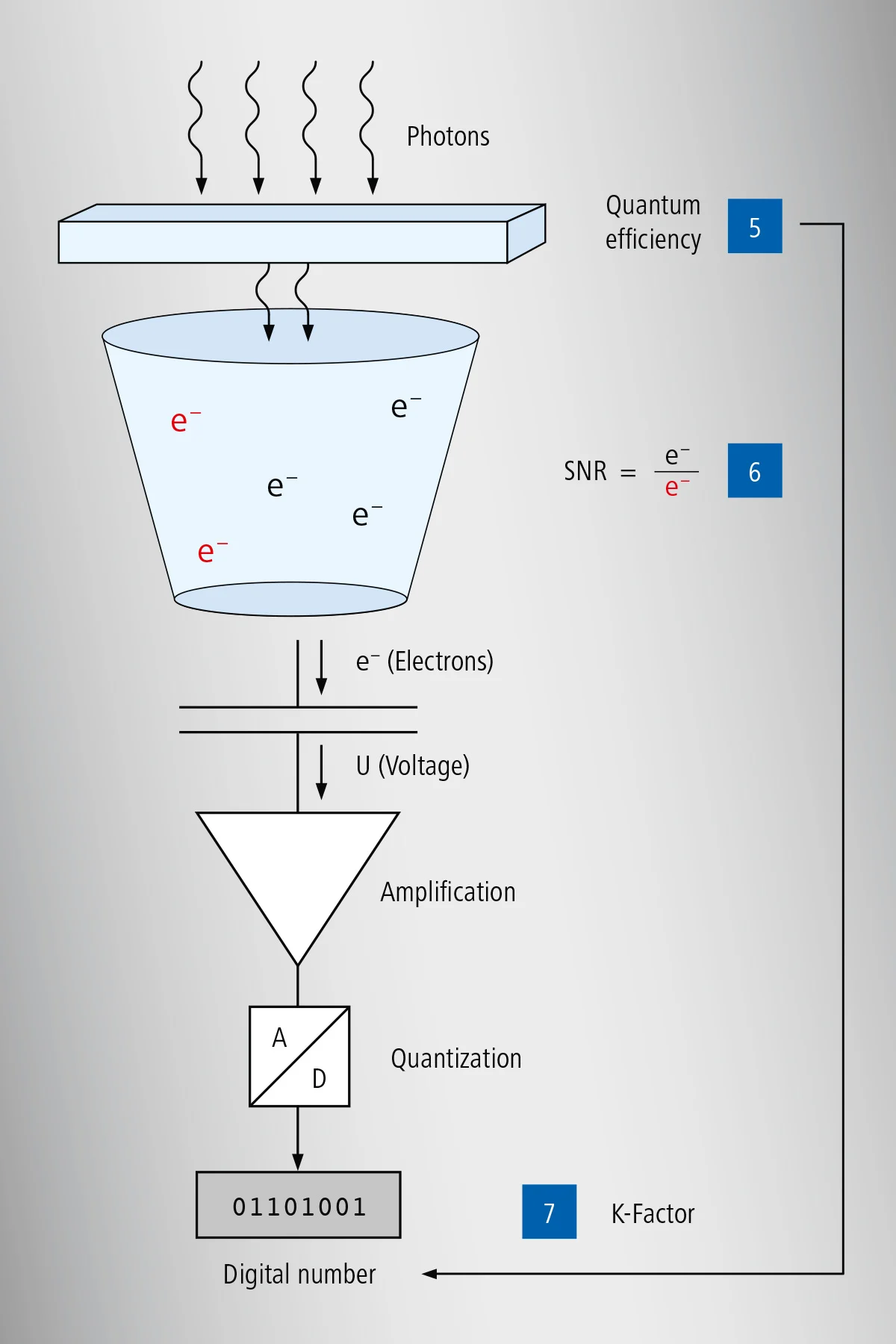
5. Quantum Efficiency [%]: Image sensors convert photons into electrons. The conversion rate, quantum efficiency (QE), depends on the wavelength. As more photons are converted into electrons, the sensor becomes more sensitive to light and more information can be obtained from the image.
6. Maximum Signal-to-Noise Ratio (SNRmax) [dB]: Signal-to-noise ratio (SNR) refers to the ratio between the gray value (corrected for dark value) and the signal noise. SNR increases with the number of photons. Maximum SNR is achieved in saturation irradiance.
7. K-Factor (Digital Number DN/e–): A camera converts electrons (e–) from the image sensor into digital numbers (DN). This conversion is defined by the system gain K. K electrons are required to increase the gray level by 1 DN. K-Factor depends on camera design, and increasing it slightly can improve accuracy at the expense of saturation capacity.
Performance Review and Benchmarking
In order to promote comparable performance among camera manufacturers, EMVA Standard 1288, created by the European Machine Vision Association (EMVA), defines uniform, objective measurement and classification methods for image sensors and cameras in industrial vision processing.
