Advantages
The latest CMOS rolling shutter cameras with Sony STARVIS sensors, such as the Baumer CX series, are an excellent choice for industrial applications with their high sensitivity and low noise levels. With their high sensor speed, these cameras have also entered the usage areas of models with global shutter sensors.
Advantages over Global Shutter Cameras:
- Simple and low-cost pixel architecture
- Low thermal output and low electronic noise
- Limited transient noise due to fast load information reading
- High resolution in compact format (up to 20 megapixels at 29 × 29 mm)
Application Examples:
- electronics: Circuit board alignment and inspection, identification (code and text reading)
- robotics: Pick & place applications
- medicine: Code and multi-code reading of product labels
- microscopy: Image analysis and documentation
Functionality
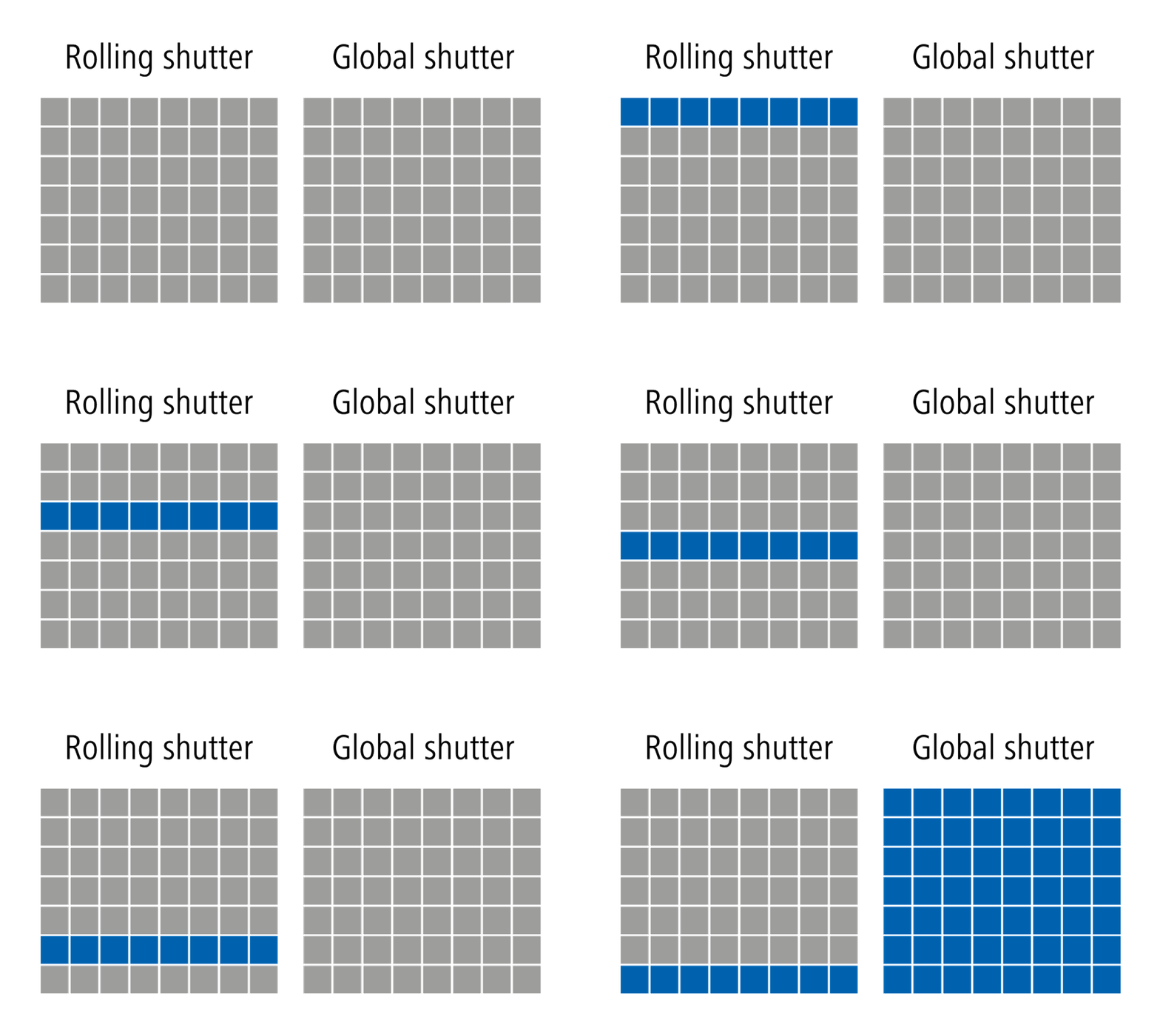
Rolling or global shutters are two types of fully electronic shutters used in CMOS image sensors. These control the amount of light (volume of photons) that is converted into electrons within the pixel at the camera sensor, which is then digitized and output as a digital value. While a global shutter sensor exposes the entire image area simultaneously and creates an image instantly, a rolling shutter sensor exposes individual lines with a time difference and outputs an image based on that.
Rolling Shutter Effect
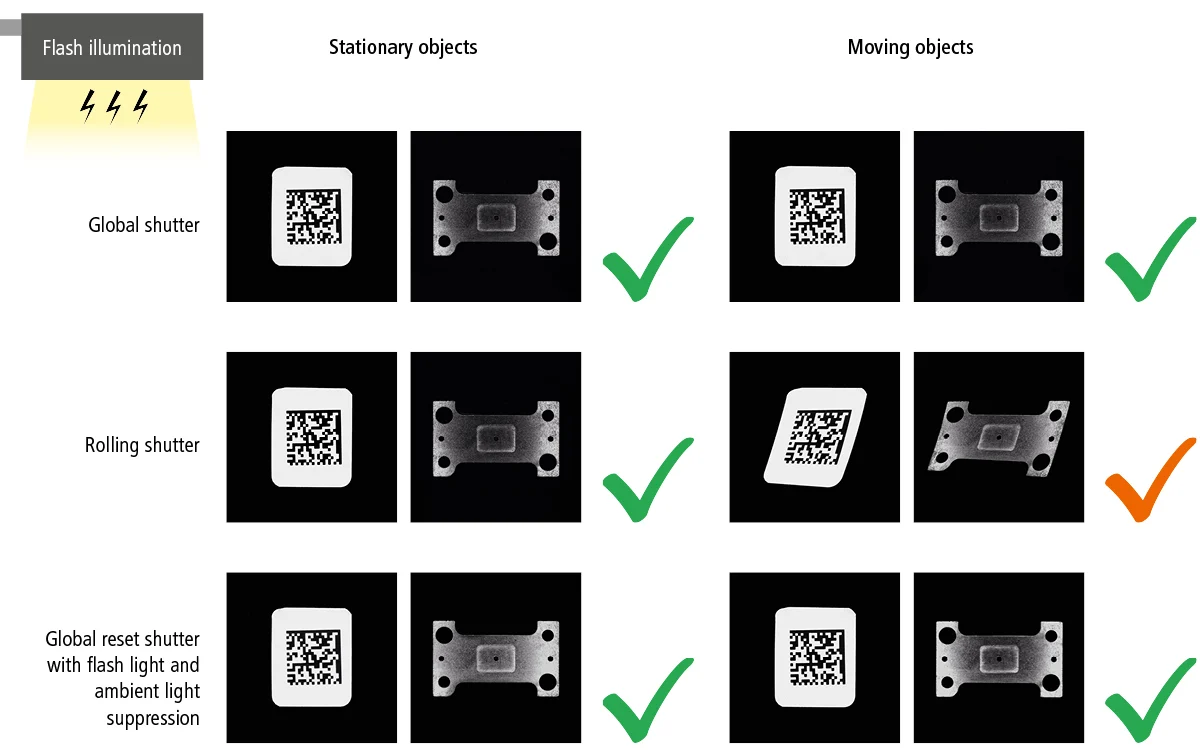
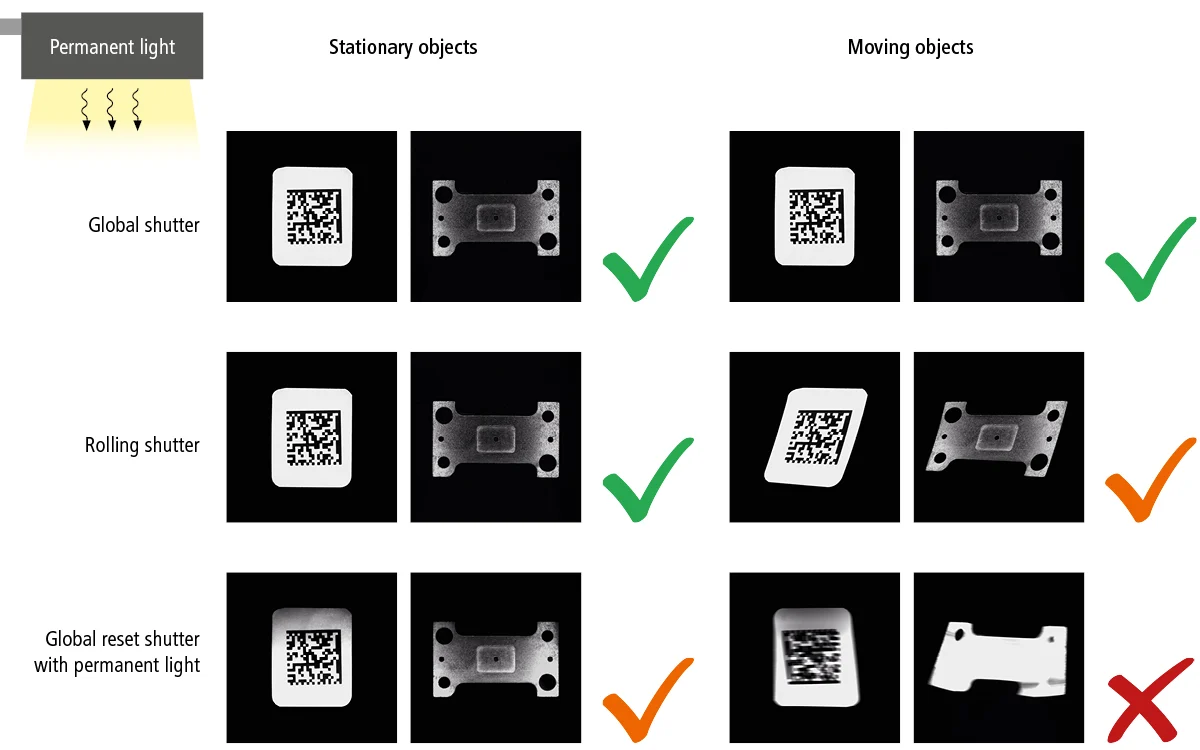
If an object moves faster than the sensor's exposure and reading time, the image may be distorted due to rolling light exposure, resulting in the rolling shutter effect.

Modern fast CMOS cameras with Sony STARVIS rolling shutter sensors significantly reduce this effect and facilitate many applications with high frame rates of up to 100 frames per second.
Preventing the Rolling Shutter Effect
Some rolling shutter sensors have a special operating mode: "global reset shutter". In this mode, all pixels are exposed simultaneously, but the reading process occurs line by line with a time difference. This way, each sensor line is exposed for a different amount of time, creating a gradual brightening of the captured image. At the same time, potential distortions caused by the rolling shutter effect remain visible, which can make reliable image evaluation difficult.
However, the rolling shutter effect can be avoided by combining the global reset shutter operating mode with flash illumination and ambient light shading. When flash light dominates the exposure and other ambient light is suppressed, all pixels receive the same amount of light. The next line by line reading and the different exposure times of the lines no longer matter because the ambient light is neutralized. If the camera is positioned so that the direction of movement of the shutter matches the direction of movement of the object, geometric distortions caused by the rolling shutter effect can be further reduced.
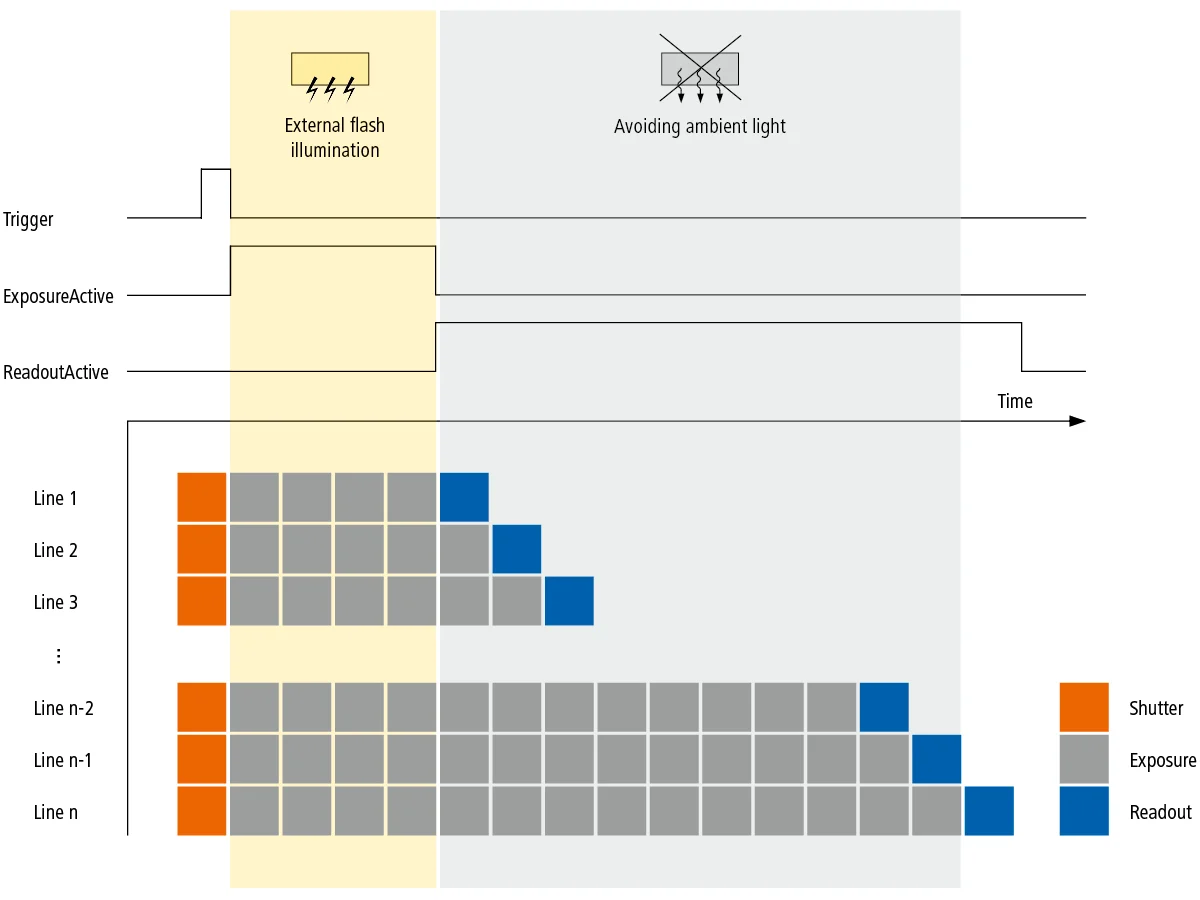
Comparison of Exposure Methods
Application Examples
If inspection objects are stationary, moving slowly, or stopped for image capture, cameras with rolling shutter CMOS sensors are an excellent choice and offer a wide range of applications.

electronics
Example: Detection of marks for circuit board alignment during assembly
electronics
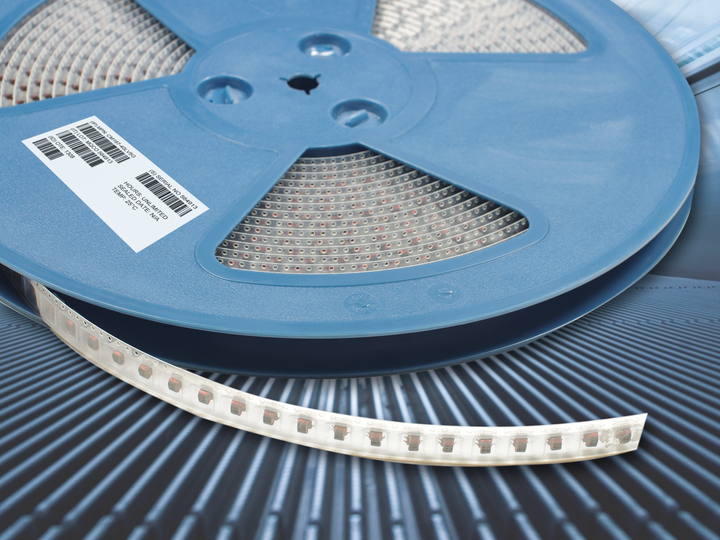
Example: Identification of assembly component rolls in warehouse systems for circuit board assembly

electronics
Example: Tracking of components and solder joints and identification code reading in inline AOI systems

robotics
Example: Fast and efficient pick & Supporting place processes

microscopy
Example: Cell analysis and documentation for medical examinations

medicine
Example: Reading multiple codes during mass production and picking in the packaging process

Beverage Industry
Example: Displaying multiple codes simultaneously (batch code reading)

Semiconductor Manufacturing
Example: Inspection of solar cells
