The Importance of Light
If it gets dark while you're reading, a lamp will help you see your work. A low-contrast paper becomes more readable when exposed to the sun. When a photographer wants to add perspective, he uses colored spotlights. The right intensity and type of illumination, which is useful in daily life, is also critical for machine vision. Lighting plays a big role in the design of image processing systems, as natural light is often not enough. Type, color and intensity affect the visibility of a test object and can therefore be captured for evaluation by cameras or vision sensors. Correct lighting aims to best highlight the features of a test object.
Type and Position
Lighting; It is divided into reflected light, dome light, dark area light and backlight. Each type of lighting has different strengths and can be used in different inspection tasks. For example, if the surface of the object is very reflective, dome lighting can prevent reflections. If cameras and vision sensors need to recognize scratches or engravings, lateral darkfield illumination is recommended.
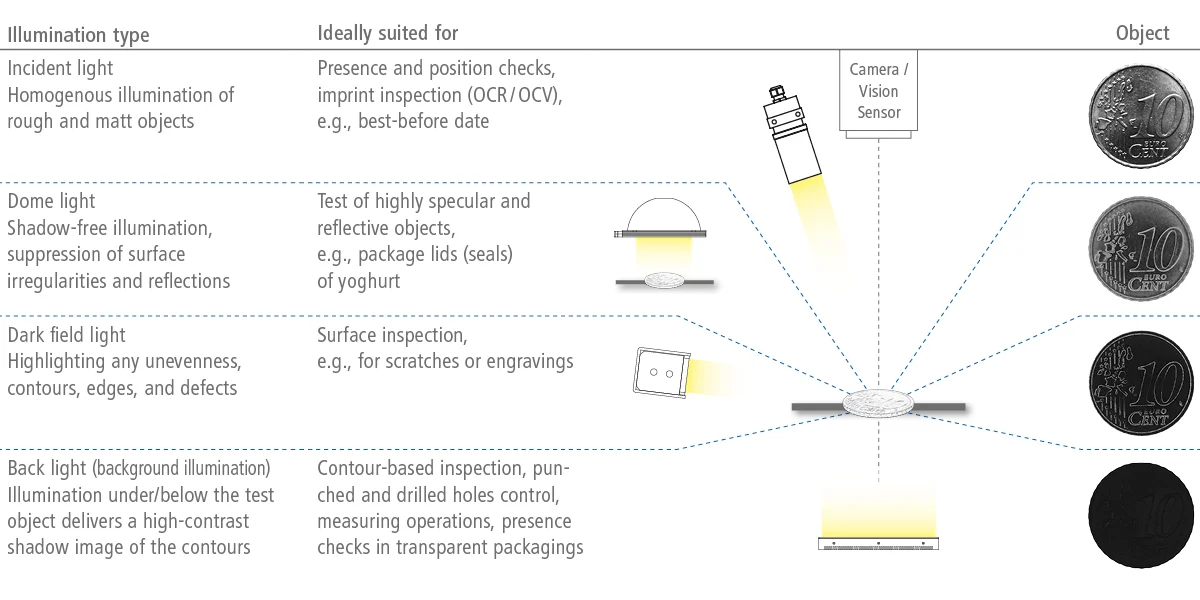
In addition to determining the visibility of a test object, other elements such as material properties such as the nature and color of the surface, environmental conditions such as outdoor light, or operating distances must also be taken into account.
Color
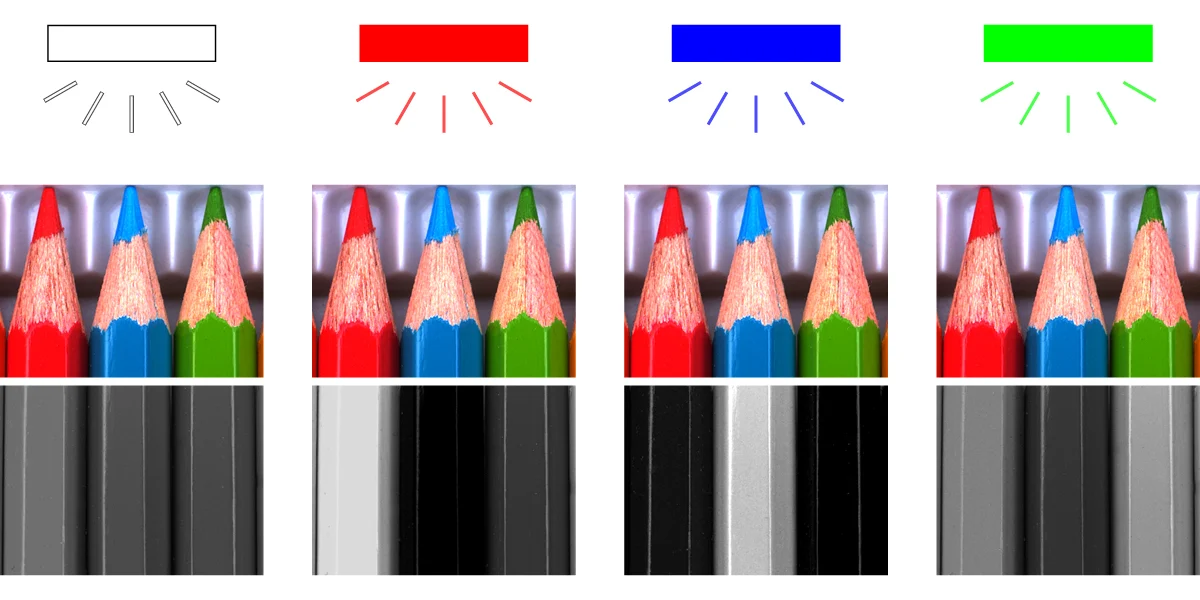
Applying different lighting colors creates contrasts that allow an inspection to be performed better or more efficiently. A color camera is not always necessary. Color lighting can highlight or suppress certain colors in monochrome images. For example, when multicolored surfaces, such as colored pencils, are exposed to blue light, the blue surfaces reflect the light most strongly while other surfaces absorb the light to varying degrees depending on their color. In this way, contrasts that are decisive for a successful application solution can be created.