Functionality and Technology of Light Barriers and Reflective Sensors
Through-Beam Sensor
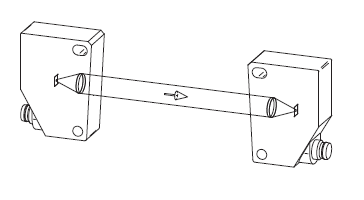
A transmitter in a separate housing transmits the light to a separate receiver. It is detected when the object interrupts the emitted ray.
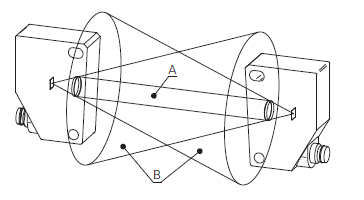
The active area (A) of the through-beam sensor is equal to the diameter of the receiver or transmitter lens. The acceptance zone (B) of the transmitter and receiver is larger. This is only important for adjustment and working near glossy surfaces. In focused laser sensors, the active area is the diameter of the laser beam if it is smaller than the receiving lens or front aperture.
Features and Benefits
Thanks to the separate configuration, long ranges and large signal redundancy can be achieved compared to equivalent reflector systems. Therefore, it is most suitable in adverse environmental conditions such as dirt, dust and humidity. The clearly defined, consistent active zone ensures high repeatability over the entire sensing distance. The switching point is independent of the surface properties of the object.
Assembly and Adjustment
The transmitter and receiver must be directed towards each other. The narrower the radiation and reception angle, the more accurately this procedure must be performed.
Reflective Sensors
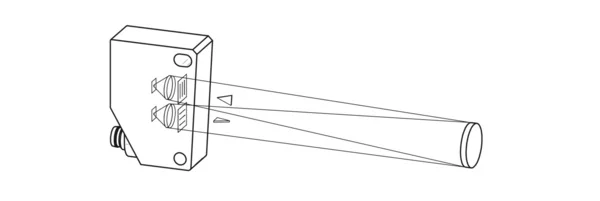
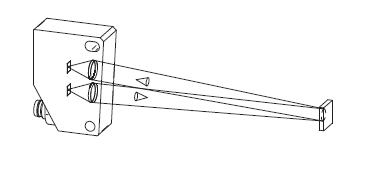
The transmitter and receiver are mounted in the same housing. The emitted infrared, red or laser light is reflected back to the receiver by a triple reflector or a reflective film. When the object interrupts the beam, the output state changes (the sensor does not receive light).
Features and Benefits
- Single Lens Optics:Since the emitted and received rays are on the same axis, the direction of approach of the object is not important and it is possible to look through small apertures. Reflectors can also be used at close range without signal interruption.
- Short Response Times:Retro-reflective laser sensors with a response time of 0.05 ms and focused laser beams accurately detect small, fast-moving objects with a diameter of 0.1 mm.
Assembly and Adjustment
Each sensor has a separate excess gain curve. Since operational reliability is highly dependent on ambient conditions, it must be ensured that the sensor operates with the highest excess signal gain.
Reflectorless Light Barrier (SmartReflect)
Unlike reflected or through light sensors, SmartReflect light barriers have a closed light beam installed between the sensor and the machine. The sensor is triggered when an object interrupts the light beam. The presence of a defined background within the sensor detection field, such as a piece of machinery, is sufficient.
Features and Benefits
Maximum Security
- Safest object detection thanks to the barrier principle
- Elimination of the weak spot caused by the reflector
- No loss of functionality due to contamination
Low Operating Costs
- No need for a separate reflector/receiver
- It does not require regular reflector replacement and expensive cleaning.
Assembly and Adjustment
The SmartReflect light curtain must be aligned with a piece of machinery in the detection area. This machine part is adjusted via teach-in.
Diffuse Sensor with Background Suppression
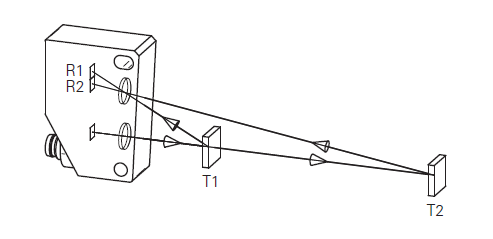
Diffuse sensors with background suppression use the triangulation principle to not only measure the light intensity reflected by the target, but also determine the distance of the object to the sensor. In this way, objects with the minimum light beam size within the adjustable detection range can be detected regardless of color and surface.
Features and Benefits
- Adjustable Detection Distance:The switching point between object and background can be precisely adjusted.
- Independent of Color:Even if the color of objects changes, the detection distance remains constant, no re-adjustment is required.
- Small Dot Size:Laser sensors can detect objects only 0.1 mm in size.
- Red Light Emitters:Visible red light allows the sensor to be adjusted by eye to small objects.
- Short Response Time:Small, fast-moving objects are detected reliably.
Assembly and Adjustment
The diffuse sensor must be directed towards the object. The detection distance should be set to a distance between the target and the background. The background must be at least as far behind the set detection distance as the detection distance reduction ratio for the color black.
Diffuse Sensors with Different Density
The transmitter and receiver are in the same housing. The emitted infrared, red or laser light is reflected directly back to the sensor by the target. If the target reflects well enough, the received light causes the sensor to switch. Surface properties, color and gloss have a great impact on the switching distance.
Features and Benefits
- Can distinguish black and white
- Relatively large active area
- Detection distance depends on the reflective properties of the object surface
- Positioning and tracking with a single sensor
- Easy assembly
- Short response time
Assembly and Adjustment
In diffuse sensors that work on the principle of density difference, the received signal level is indicated. This represents the signal level received from a white object relative to distance.
Reflective Sensors for Transparent Objects
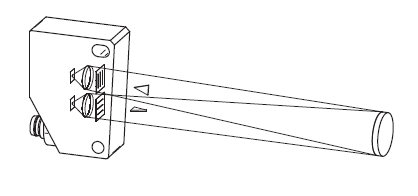
The transmitter and receiver are located in the same housing. The emitted infrared, red or laser light is reflected back to the receiver by a triple reflector or a reflective film. When the object blocks the light beam, the output state changes (the sensor does not receive light).
Features and Benefits:
- Polarizing Filter:It allows objects to be detected regardless of surface texture and color. Shiny and reflective objects are also detected reliably.
- Transparent Objects:Reliably detects transparent objects such as packaging films, PET bottles and glassware.
Assembly and Adjustment
Each sensor has a separate excess gain curve. Since operational reliability is highly dependent on environmental conditions, it must be ensured that the sensor operates with the highest excess signal gain.
