Functionality and Technology of Capacitive Sensors
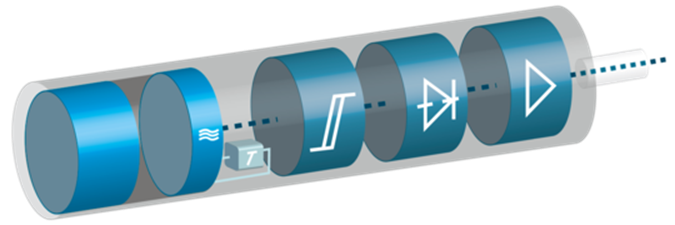
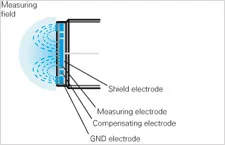
The capacitive sensor basically works like an open capacitor. An electric field is created between the measuring electrode and the GND electrode. When a material with a dielectric constant εr higher than air enters this field, the capacity of the field increases depending on the εr of this material.
The electronic circuit measures this capacity increase, the generated signal is processed in the next signal processing stage, causing the output to change by a certain magnitude.
Sensors with GND Electrodes
These sensors can be mounted by embedding the sensing surface into a material. The measuring field is formed between the measuring electrode and the integrated GND electrode, creating a defined measuring field. It is especially suitable for detecting non-conductive materials (oil, glass, wood, plastic), but can also detect conductive materials. A compensation electrode is integrated to suppress unwanted objects.
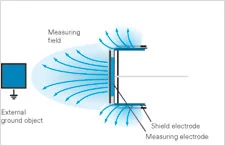
GND Electrodeless Sensors
Generally, flush mounting is not possible. These sensors allow the object to be detected to act as a GND electrode. It shows low sensitivity to contamination and condensation and is particularly suitable for level measurement tasks. For long sensing distances, the medium to be detected must be conductive and optimally grounded.
Dielectric Constant
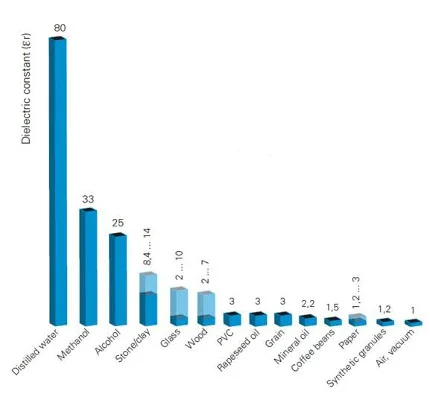
Capacitive sensors, dielectric constant εr > 1 detects conductive and non-conductive media. The dielectric constant εr (also relative permittivity or inductive capacitance) of a material indicates how much the electric flux density will increase when the corresponding material enters the measurement area instead of vacuum (air).
Conductive Media
Conductive media are generally > It has an electrical conductivity of 20 μS/cm. They can be easily detected by all types of sensors regardless of whether there is a GND electrode or not. In conductive media, the dielectric constant has no effect on the sensing distance. The detection distance is affected by the size and grounding of the object.
Conductive media include:
- water
- blood
- ink
- milk
- acetone
- metals
Non-Conductive Media
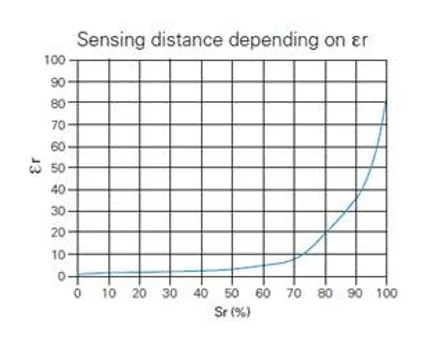
Non-conductive media are generally < It has an electrical conductivity of 20 μS/cm. In general, sensors with GND electrodes are recommended for non-conductive media. When a non-conductive object enters the sensor field, the dielectric constant of the field increases depending on the size of the material to be detected, which increases the capacity of the measurement field. The lower εr, the more difficult it is to detect the environment. In general, for plastics with εr = 3, the effective sensing distance Sr corresponds to approximately 50% of the nominal sensing distance Sn.