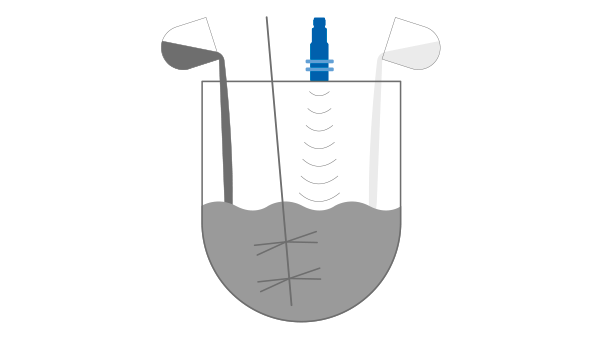
Level Measurement and Level Sensors Functionality and Technology
Level Measurement Definition
Point level detection (min/max)
Point level sensors are also called level switches. These sensors detect the presence of the environment only at a specific point. This point is determined by the mounting position of the sensor, in case of top-mounted rod probes it is determined by the rod length.
- Frequency Scan
- capacitive
- optics
Continuous level measurement (stepless)
Continuous level sensors detect fill levels steplessly in tanks or containers. Depending on the filling level, the measured value is given as a percentage or in units of length or volume. Depending on the sensor principle, measurement operations can be in contact or non-contact with the process medium.
- potentiometric
- hydrostatic
- ultrasonic
Frequency Scanning Technology
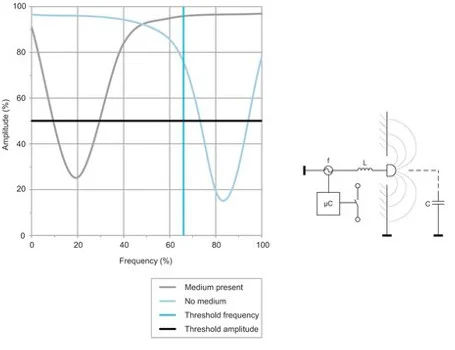
An electrode is integrated at the sensor tip, which together with the medium forms a capacitor. The dielectric constant (DC value) of the medium determines the capacitance value, and this value, together with a coil in the sensor electronics, forms a resonant circuit. The sensor switching signal is triggered according to the measured resonance frequency and programmable trigger thresholds.
The universal point level sensors of the CleverLevel series detect all types of media, whether solid, liquid or viscous, offering a smart alternative to vibrating forks.
Capacitive Level Measurement
In principle, capacitive level sensors work like an open capacitor. An electric field is created between the measuring electrode and the GND electrode. When a material with a higher dielectric constant enters the electric field instead of air, the capacity of the field increases depending on this material. This capacitance increase measured by the electronics is evaluated by signal processing and triggers the switching output when it reaches a certain magnitude.
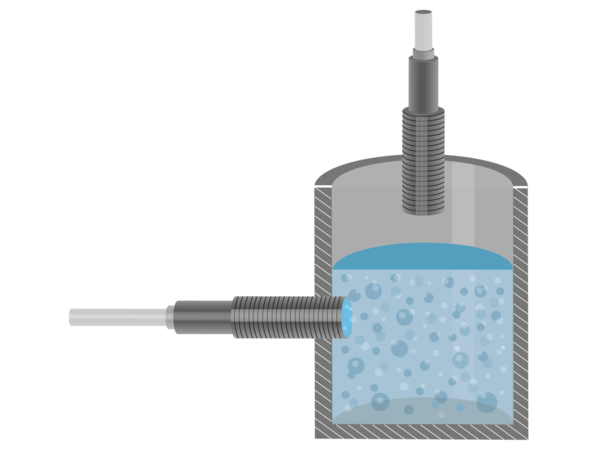
Level detection in contact with media
Capacitive sensors with durable plastic or metal housings are ideal for level detection in contact with media. These sensors offer high chemical and mechanical resistance. Sensors are mounted within the container or through an opening in its inner wall. The integrated balancing electrode prevents switching errors caused by debris and moisture accumulated on the sensing surface. In applications with direct media contact, it is recommended to use sensors with fully enclosed housing.
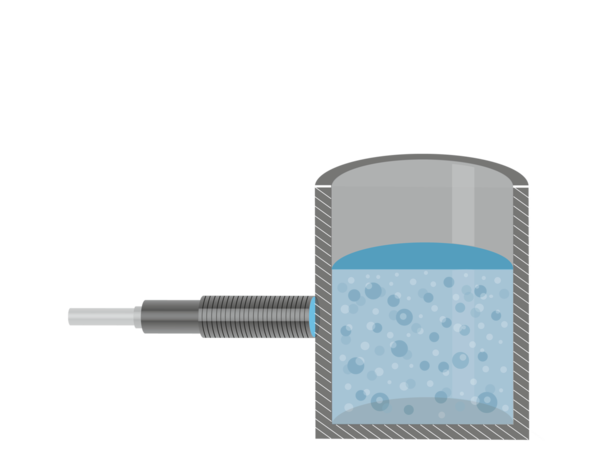
Level detection through container walls
Capacitive sensors can detect media through non-conductive container walls without any problems. This feature is particularly advantageous for sealed containers, chemically aggressive media, or media that must not become contaminated. The higher the dielectric constant or conductivity of the medium, the better the sensor can detect through the container wall.
Photoelectric Level Measurement
The principle of optical level sensors is based on the change of the critical angle for total internal reflection when the sensor tip is immersed in a liquid or surrounded by air. The sensor tip immersed in the liquid directs the light beam into the liquid and changes the switching state of the sensor output. The liquid may be electrically conductive, turbid or clear.
Level sensors mounted on hoses or standpipes operate on a similar principle, but without media contact. If the sensor tip is not immersed in the liquid, the emitted light reaches the receiver directly. When liquid enters the detection area, some of the emitted light is deflected and the amount of light reaching the receiver is reduced. The sensor can evaluate this light intensity change.
Potentiometric Level Measurement
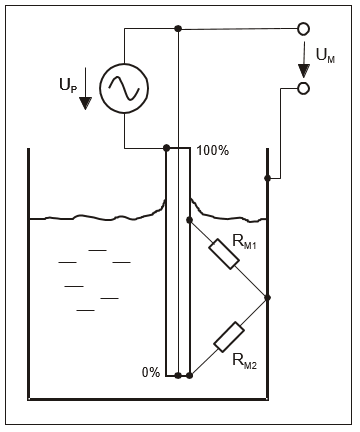
The measuring principle of potentiometric level sensors is based on the change of voltage ratio between the sensor probe and the metal tank wall. The electrical conductivity and capacitance of the liquid creates an electric flow field. In this case, the sensor probe acts as a voltage divider, where the conductivity/capacitance ratio changes depending on the filling level. The voltage rating is proportional to the filling level. Simply put, the probe and fluid system can be thought of as a potentiometer, where changes in fill level can be likened to turning a standard potentiometer.
Hydrostatic Level Measurement
The measuring principle of hydrostatic level sensors is based on pressure measurement. The pressure at the bottom of the container is detected by the measuring cell of the pressure transmitter and used to calculate the corresponding filling level. As the fill level increases, the hydrostatic pressure increases due to gravity.
Ultrasonic Level Measurement
Ultrasonic sensors work by measuring the propagation time of ultrasonic signals. These sensors send high-frequency sound waves and these waves are reflected from the surface of the medium to be detected. The medium may be in liquid or granular or powder form. Ultrasonic sensors clearly detect transparent and other difficult-to-detect objects. In continuous level measurement, ultrasonic sensors output the measured distance between the sensor and the media surface as voltage. The output current or voltage is proportional to the distance or level of the media surface.