Functionality and Technology of Temperature Sensors
Temperature sensors from Baumer's extensive portfolio meet all industry requirements and comply with process connections of international standards. Thanks to their modular structure, you can easily find the right product for every application.
Technology
Resistance Thermometer
In resistance thermometers, the measurement is based on the change in resistance of precious metals under the influence of temperature. Since every metal has a certain resistance characteristic and dU and dR exhibit an approximately proportional (linear) behavior in precious metals such as platinum, the resistance change dR can be subtracted from dU by providing a constant measurement current. To minimize self-heating of the resistance thermometer, the measuring current is selected as low as possible.
thermocouple
Thermocouples behave according to the Seebeck effect. This effect describes the occurrence of charge shifting when there is a temperature difference across a conductor. The magnitude of the charge shift depends on the electrical properties of the material. When there is a temperature difference between conductors made of two different materials, a voltage is applied at the open ends. This voltage depends on the temperature difference and the electrical properties of both materials; Since these properties and characteristics are known, temperature can be measured via voltage.
Resistance Temperature Sensors (DIN EN 60751)
The first two letters indicate the precious metal used. The following number indicates the electrical resistance at 0 °C in ohms.
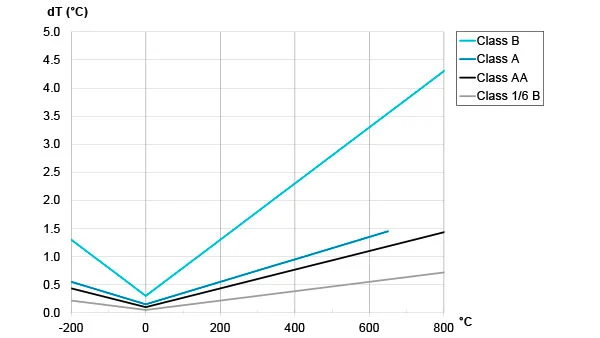
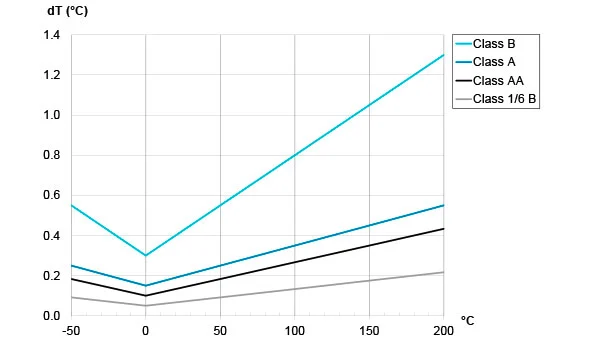
The classes defined in DIN EN 60751 define the permissible deviation and the measuring range in which these deviations are observed.
- Class A:+/- (0.15+0.002 x [ t ] ) °C; -200 to +650 °C between platinum temperature sensors
- Class AA:+/- 1/3 x (0.3+0.005 x [ t ] ) °C; -200 to +850 °C between platinum temperature sensors
- Class B:+/- (0.3 +0.005 x [ t ] ) °C; -200 to +850 °C between platinum temperature sensors
- Class 1/6 B:+/- 1/6 x (0.3 +0.005 x [ t ] ) °C; -200 to +850 °C between platinum temperature sensors
BCID System Process Connections
Baumer sensors are suitable for almost every process connection. Thanks to more than 40 connection types, you don't need to change your plant design at all. Baumer Connection Identifier (BCID) is a convenient and secure system for identifying the correct process adapter to integrate your Baumer sensor into the respective application.
Accuracy of Pt100 Classes (according to DIN/EN/IEC 60751)
Pt100 Signal Transmission
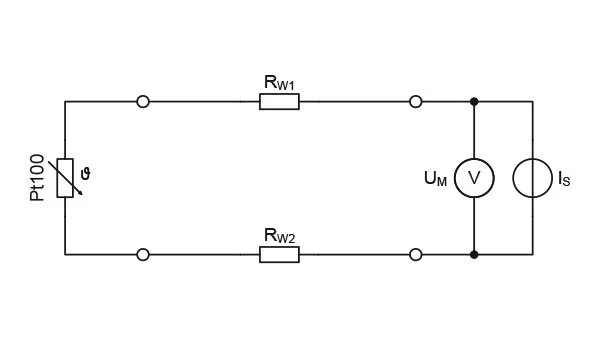
2-wire technology
It requires very little wiring. Offset error due to RW cable resistances, e.g. +0.25 °C per meter when A = 0.34 mm². Offset error can be corrected.
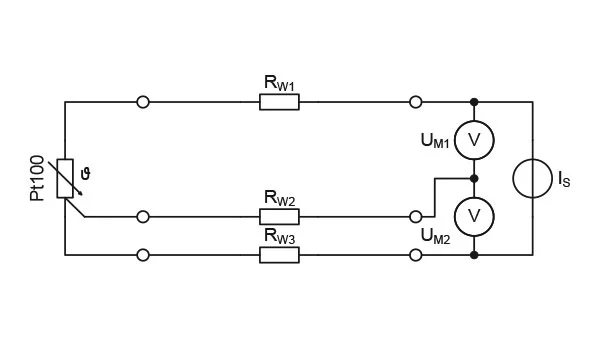
3-wire technology
It provides almost error-free transmission by measuring the error on a line. RW1 and RW3 line and contact resistances must be the same. Requires moderate wiring.
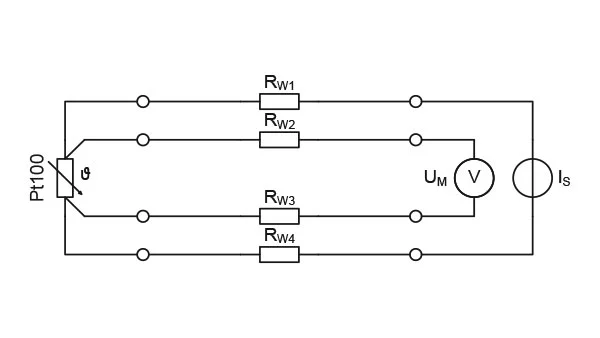
4-wire technology
It provides error-free transmission because current-free voltage measurement method is used. It is not affected by changes in line and contact resistances, eg clamps. Requires more wiring.
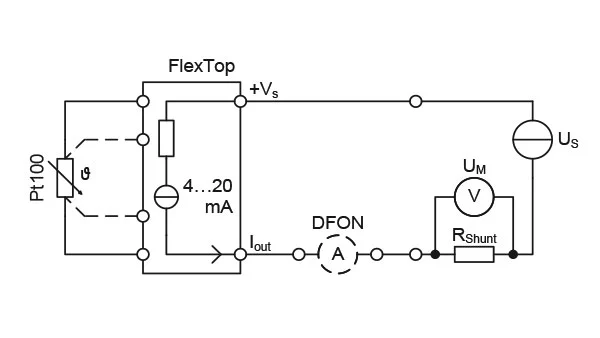
Integrated transmitter with 4 … 20 mA output
Error-free and reliable transmission with current loop signal. Control is possible at any point of the line with an ammeter or measured value indicator (e.g. DFON). It requires very little wiring. Compact transmitter available for TE2 and TER8. Higher costs due to transmitter.
Temperature transmitter FlexTop
Baumer offers a wide range of temperature transmitters that convert an RTD or T/C signal into analogue or digital communication (HART). The portfolio includes transmitters for overhead and rail mounting.
Configurable sensing elements from the FlexTop family:
RTD:The abbreviation for "Resistance Temperature Detector" is a temperature variable resistor. In addition to the standard platinum-based Pt100 and Pt1000 types, others based on copper or nickel can also be configured with FlexTop.
Pt100:RTD made of a thin platinum layer rated at 100 Ohms at 0 °C (32 °F). The calibration curve and accuracy classes are defined in DIN/EN/IEC 60751 and the resistance variation is substantially 0.38%/K. With FlexTop these and other calibration curves can be configured (with a-value).
Pt1000:An RTD like the Pt100, but with 1000 Ohms at 0 °C (32 °F) and thus a tenfold change in resistance. The same offset compared to Pt100 and when 2-wire technology is applied results in 10 times the cable length. However, greater attention should be paid to insulation failures, for example due to moisture leakage. In this context, Pt100 may be more robust.
Thermocouples (T/C):Two wires made of different metallic materials are connected together. The "thermoelectric voltage" is measured at the open ends (Seebeck effect); Depending on the material combination and temperature, this is in the millivolt range. Fully metallic sensing elements allow measurement of very high temperatures above 1800 °C (3300 °F). If the thermocouple is extended, a "compensation line" made of the same material is required. Otherwise, cold spot compensation will be impaired. In general, thermocouples (small voltage signal and cold spot temperature measurement) require more work than resistive elements.
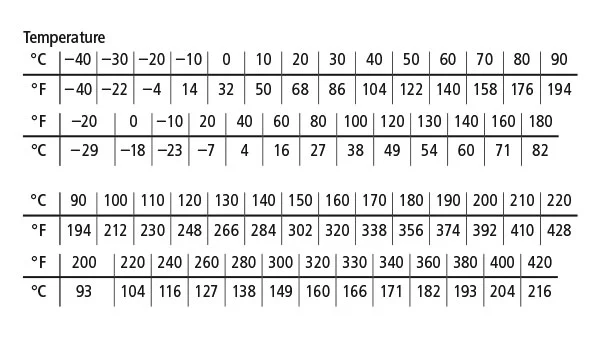
Unit Conversions