What is an Ultrasonic Sensor?
An ultrasonic sensor is a device that uses ultrasonic waves to measure distance or detect objects. It is particularly used in industrial automation technology for precise control in production processes.
How Does an Ultrasonic Sensor Work?
Ultrasonic sensors reliably measure distance within a certain range without contact, independent of object properties and ambient conditions such as the presence of dust. It emits high-frequency sound waves and measures the time it takes for the waves to hit an object and return to the sensor (time-of-flight principle). Based on the measured time, the distance between the sensor and the object is calculated by the propagation speed of sound waves. In this way, ultrasonic sensors detect the presence and position of objects precisely.
Here you can find our ultrasonic sensors for object detection, distance measurement and level measurement.
Measurement Range of Ultrasonic Sensors
The measuring range of ultrasonic sensors varies depending on the sensor principle, model and environmental factors; typically ranges from a few centimeters to several meters. Important factors for the measurement range are the frequency and amplitude of ultrasonic waves, transmitter performance and receiver sensitivity.
Distance Measurement
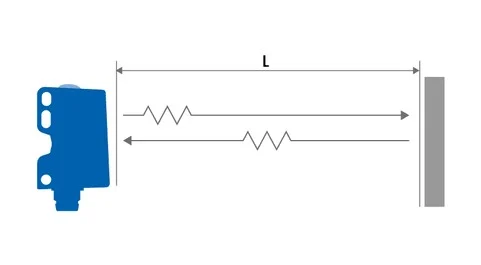
Distance is measured by detecting and calculating the time between ultrasonic wave propagation and reception. Distance calculation uses the following formula:
Distance L = (T x C)/2
In this formula, L represents distance, T represents the time between sound wave propagation and reception, and C represents the speed of sound. The calculated value needs to be divided by two, since T is the total round-trip time of the sound waves.
Principles and Structure of Ultrasonic Sensors
Most ultrasonic sensors are based on measuring the propagation time between sending and receiving sound (proximity sensor). The barrier principle determines the distance between the sensor and a reflector (retro-reflective sensor) or an object (transitive sensor) in the measuring range.
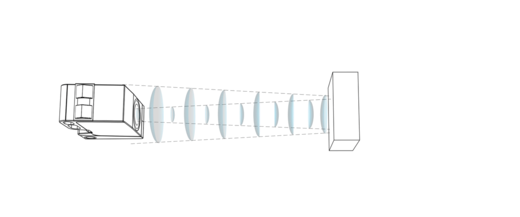
Proximity Sensors
Ultrasonic proximity sensors are the simplest form of ultrasonic object detection. The transmitter and receiver are integrated in a single housing. The ultrasonic waveform is reflected directly back to the receiver from the object to be measured. Moreover, ultrasonic sensors with teach-in function differ from conventional types by offering easier and more diverse operability at the push of a single button.
Typical Applications:
- distance measurement
- Stack height measurement
- Part presence detection
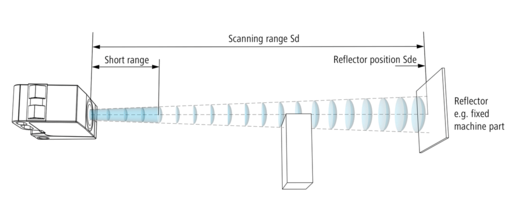
Retro-reflective Sensors
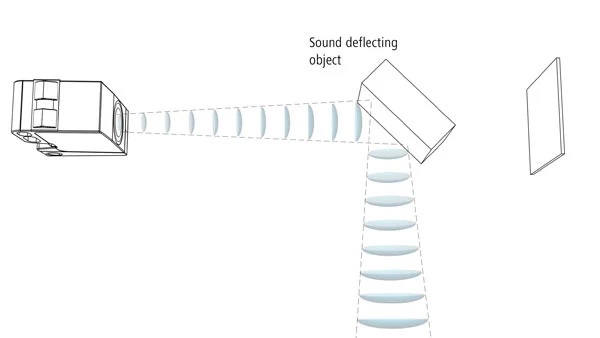
Retro-reflective sensors work on a similar principle as ultrasonic proximity sensors. Sound propagation measurement distinguishes the distance between the sensor and the reflective background or target to be detected, and the output is triggered when the closer object is detected. Any stationary object that reflects sound can be used as a reflector.
Typical Applications:
- Irregularly shaped and curved objects
- Sound deflecting target objects
- Sound-absorbing materials such as cotton and foam rubber
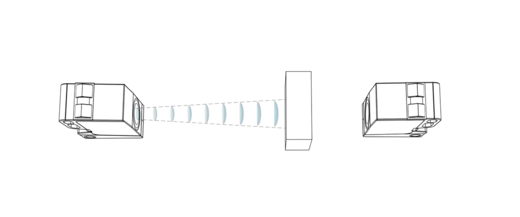
Transient Sensors
Ultrasonic transient sensors are known for their fast response times and long detection ranges. In this configuration, the transmitter and receiver are two separate parts. The receiver monitors the sound wave coming from the transmitter and changes its output state when that wave is blocked.
Typical Applications:
- Detection of fast moving objects
- Counting objects from difficult-to-detect materials (glass containers, PET bottles)
- Monitoring transparent materials
- Movie break viewing
- Level monitoring in tanks and silos
Ultrasonic Proximity Sensors
Design and Working Principle
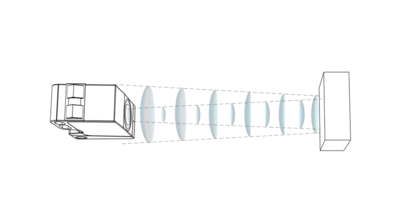
A special sound transducer is used for ultrasonic proximity sensors, which allows sound waves to be transmitted and received alternately. The sound waves emitted by the transducer are reflected by an object and received back in the transducer. After emitting sound waves, the ultrasonic sensor switches to receiving mode. The time between propagation and reception is proportional to the distance of the object from the sensor.
Digital Output
Detection is only possible within the detection area. The required detection range can be set via the sensor's potentiometer or electronic Teach-in (Teach-in button or remote Teach-in). If an object is detected in the specified area, the output state changes and this is visualized by the integrated LED.
Target Detection
While sound waves reflect best off hard surfaces, targets can also be liquids, granules or powders. In general, ultrasonic sensors are used for object detection in situations where optical principles cannot be reliable.
Standard Target
The standard target when defining the sensor's nominal detection range is a square flat object with one of the following dimensions:
- 15 x 15 mm (Sde up to 250 mm)
- 30 x 30 mm (Sde up to 1000 mm)
- 100 x 100 mm (Sde > 1000 mm)
The target must be mounted perpendicular to the sensor axis.
Target Size
To ensure reliable object detection, the reflected signal must be strong enough to be read by the sensor. The signal intensity depends on the size of the object to be detected. Using a target of the minimum required size or larger ensures that the full scanning distance Sd is achieved.
Target Surface
Detection of sound-absorbing materials results in a reduction in the maximum detection distance. Moreover, the maximum detection distance can be achieved as long as the maximum roughness of the object does not exceed 0.2mm.
Typical Sound Absorbing Materials:
- foam rubber
- cotton/wool/fabric/felt
- Highly porous materials
Sound Cone Profiles
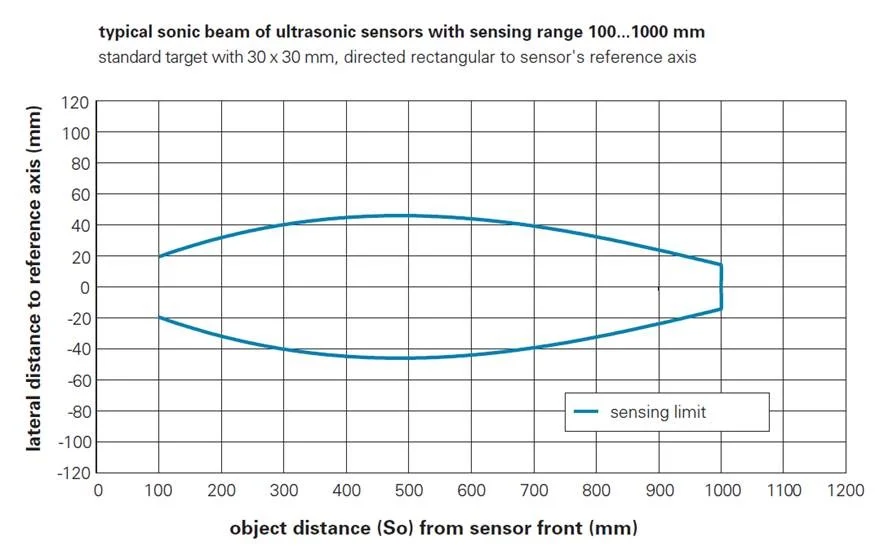
The sound cone profile tables found on the specification sheets in this catalog represent active detection areas for ultrasonic sensors. The charts show short-range audio sidelobes that widen the sensor's short-range aperture angle. The lobes decrease over longer distances due to sound absorption and air diffusion. The size, shape, surface properties and orientation of the target detection have a large impact on the side detection region of an ultrasonic sensor. Sound cone profiles are valid for the entire product family; for example, the 100 - 1000 mm profile is representative for all relevant sensors in the same detection range - digital or analog outputs, etc.
Measurement Method
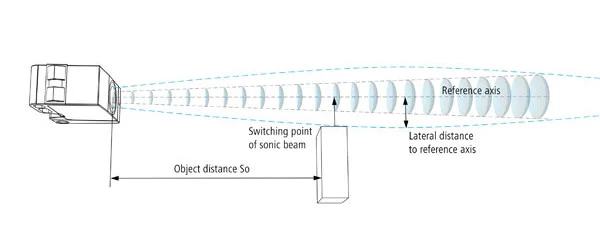
Standard square targets are made of steel to determine the shape of typical sound cone profiles:
- 15 x 15 mm (Sde up to 250 mm)
- 30 x 30 mm (Sde up to 1000 mm)
- 100 x 100 mm (Sde > 1000 mm)
Targets are placed perpendicular to the reference axis of the sensor and approached from the sides at different distances. The sound cone profile is drawn by connecting the measured points with a line. The conical shape may change when round or differently shaped objects are detected.
Ultrasonic Retro-reflective Sensors
Design and Operation
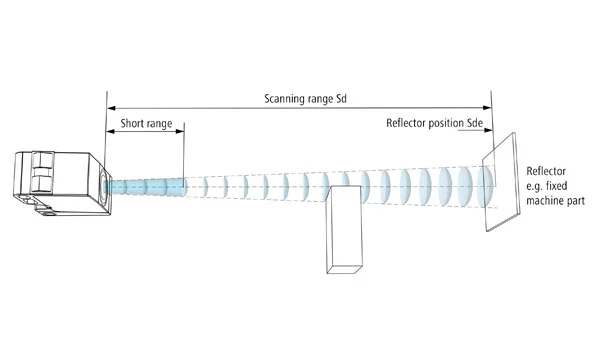
The retro-reflective ultrasonic sensor works similarly to a proximity sensor. The distance between the sensor and the reflector or a target within detection range is determined by measuring the propagation time. Any sound-reflecting fixed object can be used as a reflector. The sensing distance of the sensor (Sd; the distance from the sensor to the reflector) can be adjusted with the sensor's potentiometer or IO-Link (if the sensor has this feature). As long as the measured propagation time of the ultrasonic signal corresponds to the distance from the sensor to the reflector, the output of the sensor remains inactive. When a target enters the detection area and changes the sound wave propagation time, the sensor changes its output state. This enables detection of most materials, including sound-absorbing objects.
Object Detection
Standard Object/Reflector
The standard target is defined as a square, flat object with a side length of 30 mm (Sde > 1000 mm: 100 mm side length, Sde ≥ 2500 mm: 300 mm side length), perpendicular to the sensor reference axis. The reflector should be made of a material with good sound reflecting properties and should be at least as large as the target.
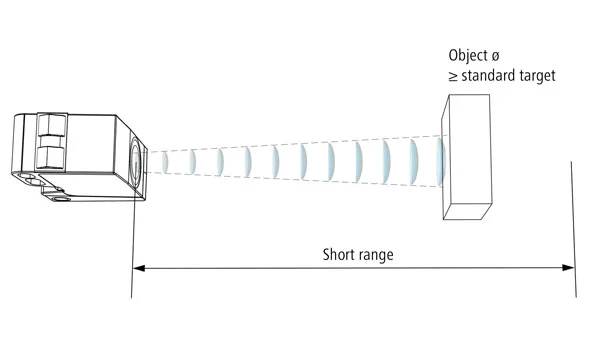
Objects at Close Range
For reliable detection, the sound cone must be completely covered and there must be no echo from the reflector. The required object diameter must be at least 30 mm for URDK 30 and at least 100 mm for URAM 50.
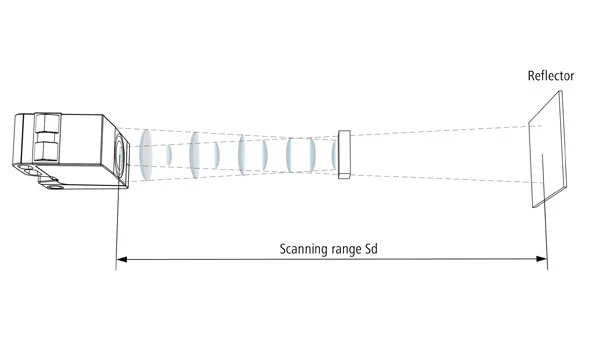
Objects in Rest of Operating Range
The reflected signal must be strong enough to ensure reliable object detection. The strength of the reflected signal depends on the size of the object. For a standard object or a larger object, the full detection distance (Sd) can be used.
Advantages
- Easy detection even for 100% sound-absorbing materials
- Reliable detection of sound-reflecting objects
- No blind zone in front of the sensor for standard objects
Ultrasonic Barrier Sensors
Design and Working Principle
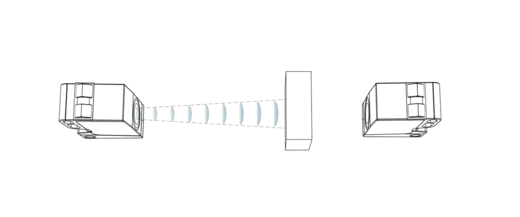
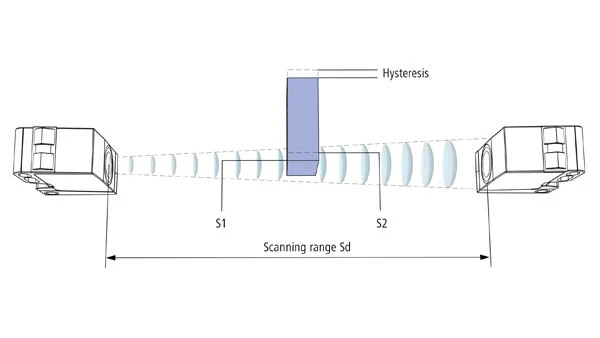
In this scenario, the transmitter and receiver are located in separate enclosures. The transmitter produces a continuous sound wave that is received by the receiver. An object interrupting the sound wave causes the receiver to react and change its output state.
With the help of a built-in potentiometer or IO-Link (if available), the user can adjust the strength of the transmitted sound wave.
The status and signal intensity of the output stage are indicated by an LED.
Sonic Beam Angle (α)
The sonic beam angle (α) defines the boundaries of the cone beam emitted by the ultrasonic barrier sensor.
repeatability
Thanks to the narrow angle of the sonic beam, the repeatability of the switching point of two consecutive targets under the same conditions is better than 3 mm.
hysteresis
Hysteresis is the difference between the operating point (S1) and the release point (S2). If an object interrupts the sonic beam, the signal level must be increased by approximately 75% to reset the output signal. In this way, consecutive objects can be easily detected.
Ultrasonic Distance Sensors
Design and Working Principle
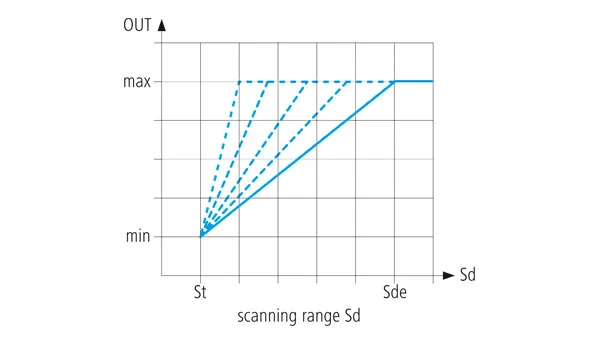
In ultrasonic distance sensors, the emitted current or voltage is proportional to the distance of the detected object. Based on the pulse-echo principle, the measured distance value is output as a voltage value. Depending on the sensor, the steepness of the output curve can be adjusted via potentiometer, teach-in or qTeach to suit the resolution required by the application. In applications with long supply lines or strong interference, it is recommended to use an ultrasonic distance sensor with current output.
Where are ultrasonic sensors used?
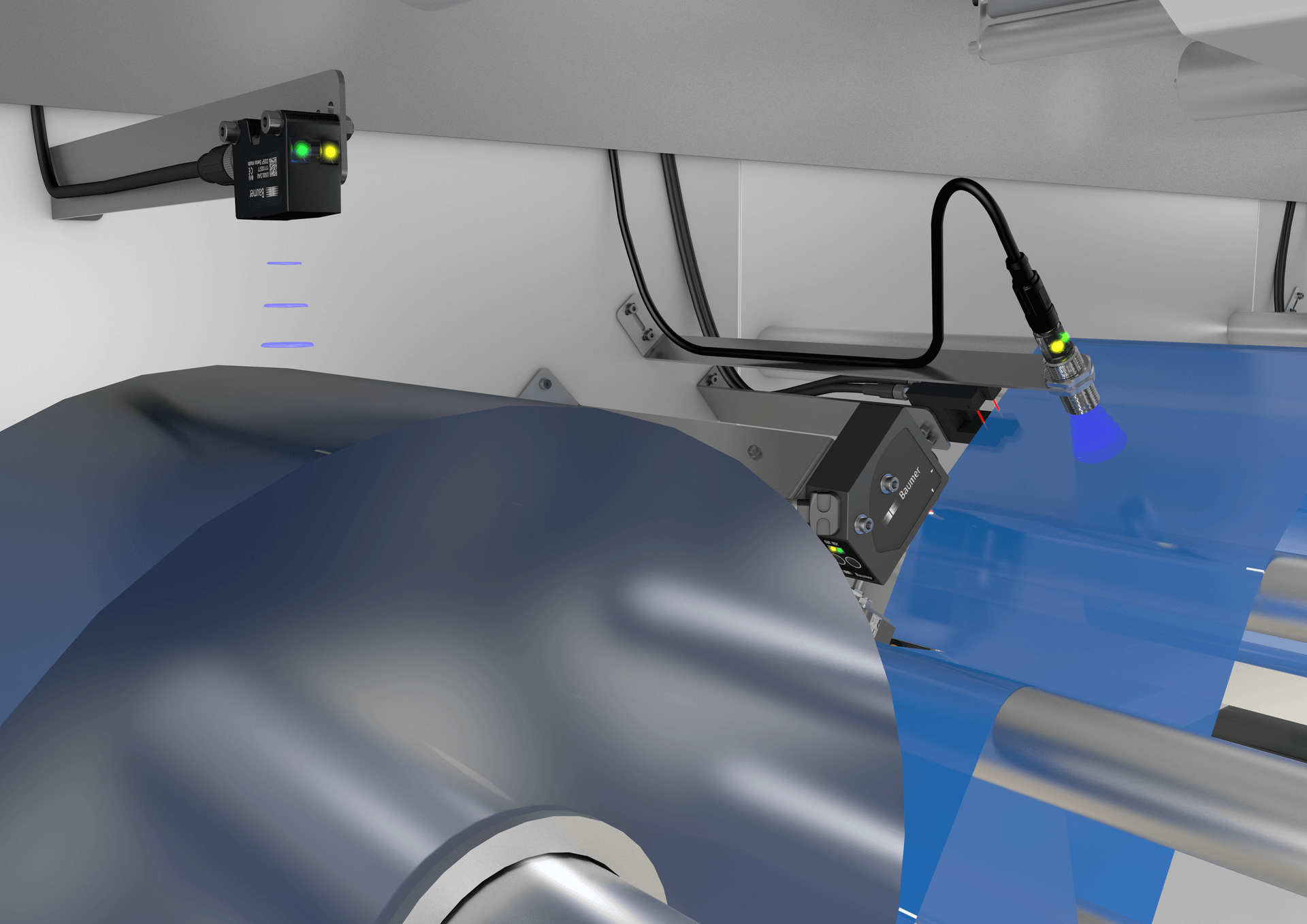
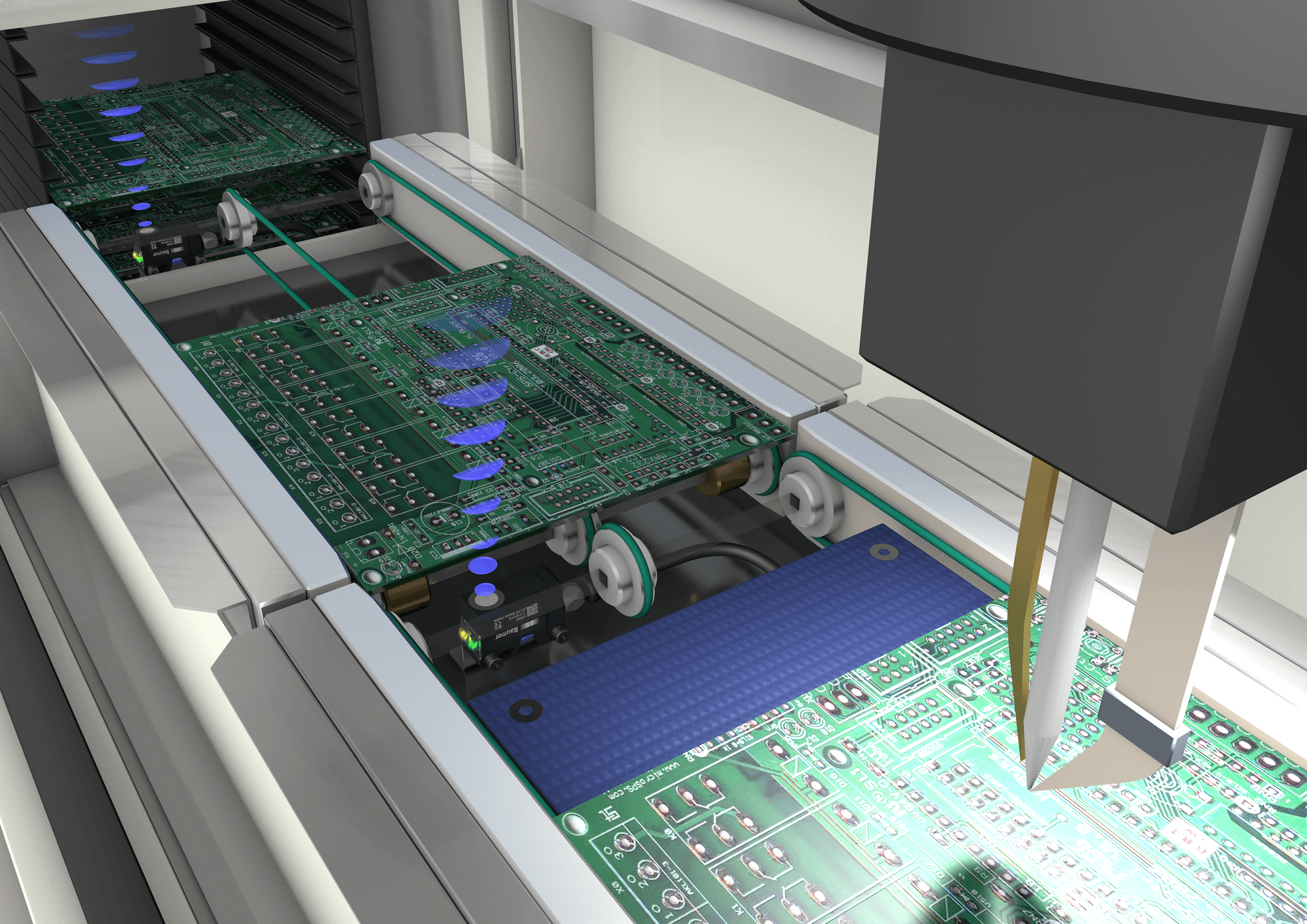
Ultrasonic sensors are versatile devices suitable for almost any sensing or measurement task in industrial applications. Objects to be detected can be solid, liquid, granular or powdery. These sensors reliably detect transparent or high-gloss objects, as well as objects that change color. Since they are extremely resistant to dust, smoke and fog, they do not adversely affect process reliability in harsh working environments.
Thanks to their diversity of applications, ultrasonic sensors are used in various industries such as packaging, electronics and feeding technology. Here you can find typical application examples of ultrasonic sensors and their advantages in specific applications.
Typical applications of ultrasonic sensors:
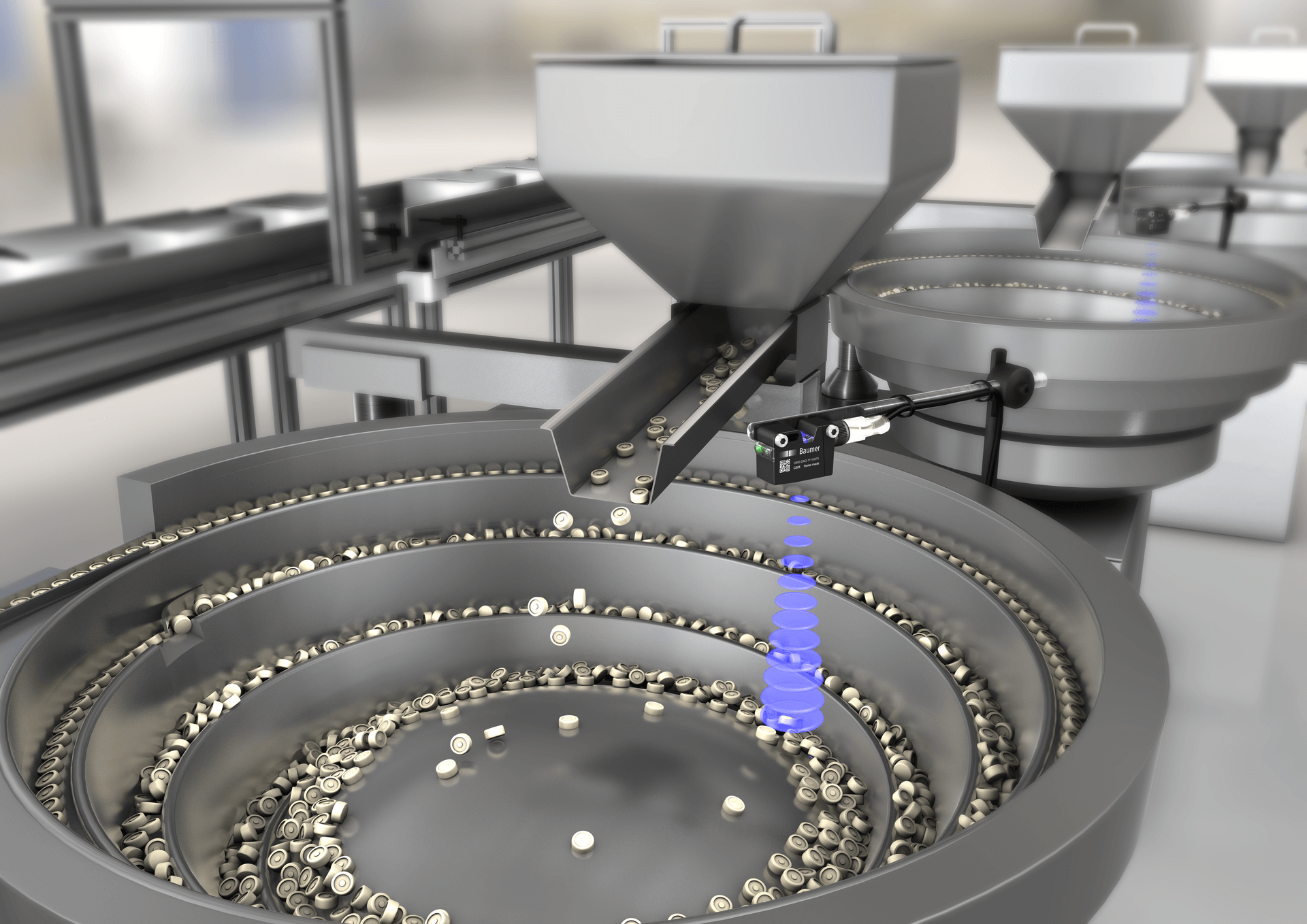
To learn more about the benefits of Baumer ultrasonic sensors, watch the video below:
Using multiple ultrasonic sensors in parallel and avoiding mutual interference
In parallel operation of multiple ultrasonic sensors, consider the following to avoid detection errors due to mutual interference:
- Spatial arrangement: Place sensors at sufficient distance and at different angles; If necessary, use separation walls or sound-absorbing materials to minimize direct interference between sensors.
- Electronic system and software: Apply advanced algorithms and filter out interference by assigning an identification code to each sensor, allowing the system to respond to the target sensor's data.
- Synchronization and clock: Implement time slots or synchronous triggering so that each sensor transmits and receives data at a specific time interval.
Installation of ultrasonic sensors
Professional installation of ultrasonic sensors is crucial for optimum performance and reliability in various applications such as precise distance measurement or object detection. Learn more about the installation and commissioning of ultrasonic sensors.
